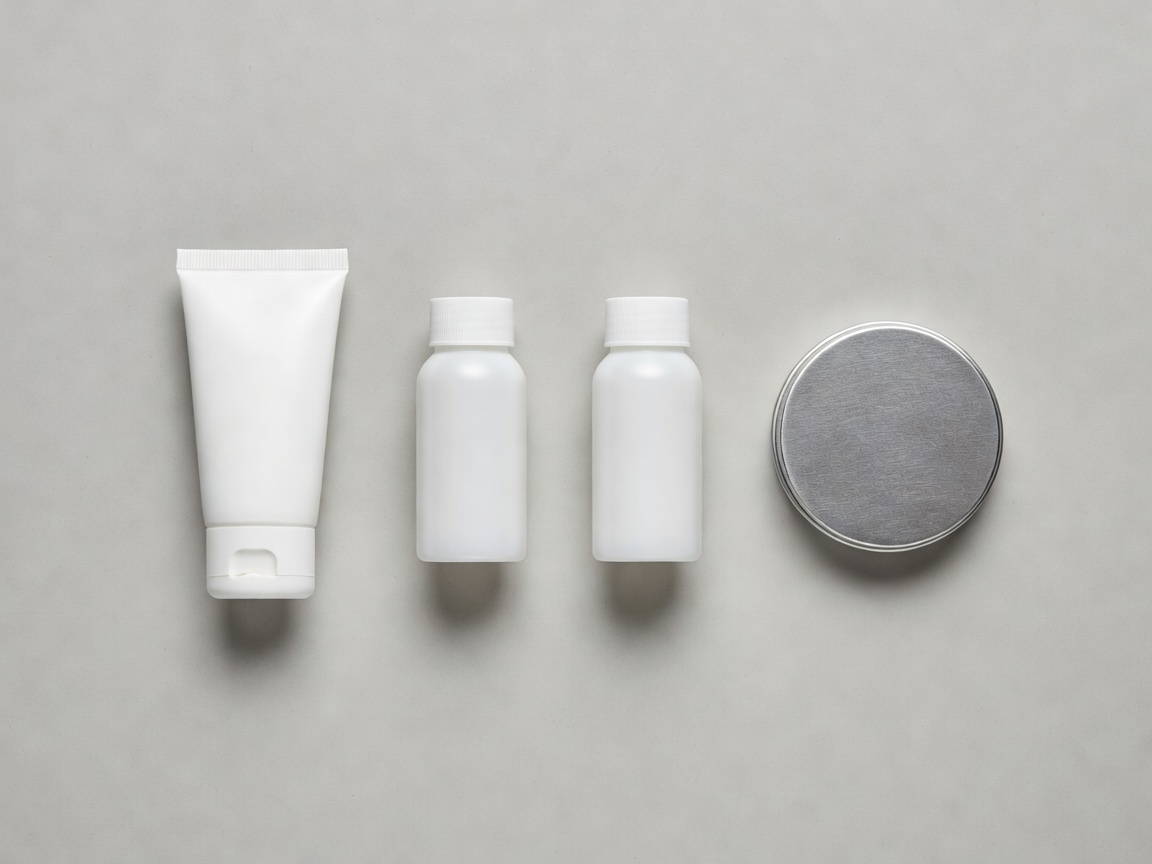
Calculating realistic volume requirements before you pack
Commercial "weekend travel kits" often bundle identical 30 mL bottles of cleanser, toner, serum, and sunscreen. In outdoor practice, consumption rates across categories are highly unequal. While 30 mL of concentrated facial cleanser easily lasts three weeks, 30 mL of sunscreen is barely enough for two full-body applications.
Container resin codes and pressure-differential behaviour
Commercial airliners pressurise cabins to an equivalent altitude of 1,800–2,400 metres (6,000–8,000 feet), while mountain passes reach much higher. Air trapped inside a rigid or semi-rigid bottle expands as ambient pressure drops, forcing liquid past weak flip-top closures if the bottle is stored inverted.
| Container Material | Resin / Material Type | Chemical & UV Compatibility | Altitude & Crush Durability | Best Assigned Contents |
|---|---|---|---|---|
| Opaque HDPE / PP Bottles | #2 HDPE or #5 Polypropylene | High resistance to surfactants, oils, and glycols; blocks light transmission. | Virtually unbreakable; screw-cap reducers outperform flip-caps at altitude. | Liquid cleansers, body lotions, micellar waters. |
| Clear PET Bottles | #1 Polyethylene Terephthalate | Good barrier to oxygen and water, but transmits UV light; rigid walls crack if frozen solid. | Rigid walls cannot be squeezed prior to capping to create negative pressure. | Short-trip aqueous gels or non-light-sensitive washes. |
| Flexible Silicone Tubes | Cross-linked Silicone Elastomer | Permeable to volatile silicones, essential oils, and some organic solvents over weeks; causes product drying. | Soft and crush-proof, but wide collars can pop open under heavy pack compression. | Short-term aqueous body wash or shampoo only; never store sunscreen in silicone. |
| Lined Aluminium Tubes & Tins | Epoxy-phenolic lined Aluminium | Impermeable to light and air; collapsible walls prevent air suck-back. | Zero air headspace means minimal pressure expansion; sharp creases can pinhole after repeated folding. | Factory sunscreens, barrier ointments, solid syndet bars. |
Why sunscreen must stay in its original factory container
While decanting cleansers and plain moisturisers is standard practice for ultralight packers, sunscreen formulations are thermodynamically delicate emulsions or suspensions. Organic UV filters and dispersing agents can migrate into unlined plastic walls (particularly silicone and low-density plastics), lowering the active filter concentration. Furthermore, original packaging displays the batch lot code, expiration date, or Period After Opening (PAO) symbol (such as 12M), plus the active ingredient panel required by border security or medical personnel if an allergic contact reaction occurs.